The question of how to clean dentures is frequently searched by denture users. However, the most important factor in denture cleaning is whether the denture is fixed or removable. Fixed dentures should be brushed regularly twice a day. In addition, using interdental brushes or dental floss while cleaning fixed dentures helps prevent bacterial plaque formation.
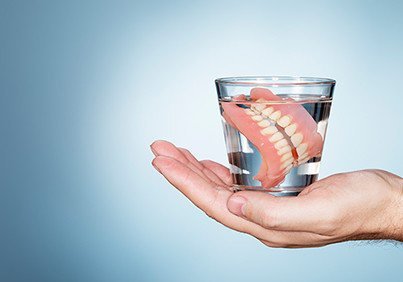
The cleaning of removable dentures is different compared to fixed dentures. Individuals with removable dentures should rinse their dentures thoroughly with plenty of water after each meal. In addition, removable denture users should soak their dentures in water overnight. Care tablets specially produced for removable dentures should be used twice a week.
In addition to these practices, for all types of dentures, thorough rinsing with plenty of water and cleaning procedures should be applied to remove food residues accumulated between the teeth.
Why Are Dentures Made?
The number of denture users is increasing day by day. Dentures, which were previously preferred especially at older ages, are now frequently applied to middle-aged individuals as well. So, why are dentures made? Dentures, also known as dental prostheses, are a treatment method that replaces missing natural teeth and performs the same functions after tooth loss or delayed tooth extraction. Teeth broken due to severe trauma can be extracted upon the patient’s request and replaced with dentures. Thanks to dentures, patients can smile confidently again and regain dental aesthetics.
Denture Models
There are many types of dental prostheses. Denture models are determined according to the patient’s condition. Denture models are as follows;
- Removable Dentures; These are the most commonly used prosthetic models today. If the patient has significant tooth loss, removable dentures are often recommended by dentists. These dentures can be easily removed and inserted by the patient.
- Fixed Dentures; These denture models are made similarly to crowns or bridges. Adhesives are used in fixed dentures. Due to their structure, patients cannot remove or insert them themselves.
- Total Dentures; If a person has lost all of their teeth, this is the type of denture most commonly recommended and applied by dentists.
- Precision Dentures; This model is preferred by individuals who care about dental aesthetics. It is applied to people with partial tooth loss.
- Partial Dentures; These are prosthetic models used for teeth that are lost or broken at different intervals. They are applied to the patient’s mouth using materials such as clasps and hooks.
- Implant-Supported Dentures; This prosthetic model is divided into two types: fixed and removable. Fixed implant-supported dentures are applied in cases of partial tooth loss. The prosthesis, supported by implants, is applied as a crown or bridge. Removable implant-supported dentures are used when all teeth are missing. In cases where bone structure is insufficient, additional support is obtained from implants.
5 Important Tips for Denture Care
Oral care is extremely important. Especially denture users should clean their prostheses twice a day. If dentures are not cleaned regularly, serious problems may occur. Initially, food residues accumulate on unclean dentures. Over time, bacteria multiply and may cause sores in the mouth. According to dentists, the 5 important tips for denture care are as follows;
- Individuals using removable dentures should clean their prostheses after each meal as recommended by dentists. Otherwise, food residues may accumulate under the denture.
- To prevent bad breath, dentures should be removed every night and soaked in water.
- Some products used to clean dentures may abrade the surface and reduce the lifespan of the prosthesis. Especially bleach or detergents should never be used for cleaning dentures. Instead, antibacterial care tablets specifically produced for dentures should be used, and the dentures should be soaked overnight. Individuals using total dentures should regularly clean their dentures twice a day using cleaning gel and a brush. It is also important to choose brushes suitable for dentures.
- While brushing dentures, maintenance should be carried out inside a towel or a denture container to prevent breakage.
- Denture users should visit their dentist for a check-up every six months. By following these five recommendations, the lifespan of dentures can be extended.
Choosing the Right Brush for Denture Cleaning
Just as regular oral care is important, denture care should not be neglected and should be performed routinely. The brush selection for denture cleaning should be as follows;
- Hard-bristled brushes may scratch dentures. Therefore, brushes with medium or soft bristles should be preferred.
- In addition to standard brushes, there are double-headed toothbrushes specially designed for dentures. One of these heads has a conical shape and fits into the inner surface of the denture. It is comfortable to use for partial dentures. The other head has a wider structure with traditional bristles and is designed for brushing larger and outer surfaces.
- The bristle hardness of denture toothbrushes is designed according to the outer and inner surfaces of the denture.